How Nutritionists Get High-Value Bookings (Sell Progress, Not Plans)
Clients comparison-shop one-off consultations.
High-value clients don’t. They buy what happens between visits—visibility into meals, adherence when life gets messy, and clear proof of progress.
If your offer is still “book a session, get a plan,” you’re competing on price. If you sell a progress system, you compete on outcomes.
Here’s how nutritionists turn that into bookings that retain—and command more 👇

Unidirectional consultations are outdated
A unidirectional consult looks familiar: you assess, hand over a plan, say “see you in four weeks,” and hope the PDF sticks.
That model is outdated—and it isn’t how modern dietetics is designed.
The Academy of Nutrition and Dietetics’ Nutrition Care Process is a circle, not a one-way talk. Assessment, diagnosis, and intervention only work when followed by monitoring and evaluation, then reassessment as new data arrives (Writing Group of the Nutrition Care Process/Standardized Language Committee, 2008).
The outcome research agrees that one visit isn’t enough:
📊 Multiple face-to-face MNT sessions over months improved lipids, blood pressure, glycemic markers, and BMI—evidence that supports 3–6 visits over 3–6 months, not a single advice dump (Sikand et al., 2018; Mohr et al., 2023).
📊 For adult overweight and obesity, Academy guidance recommends at least five interactive sessions when feasible; interventions with ≥5 contacts reached nearly 5% weight loss, while fewer contacts were weaker on several outcomes (Morgan-Bathke et al., 2023).
Offer implication: package 8–12 week (or 3–6 month) programs with built-in reviews—not hourly “consultations.” That’s what high-value bookings look like.
Target accountability—not only follow-ups
A reminder ping is not accountability.
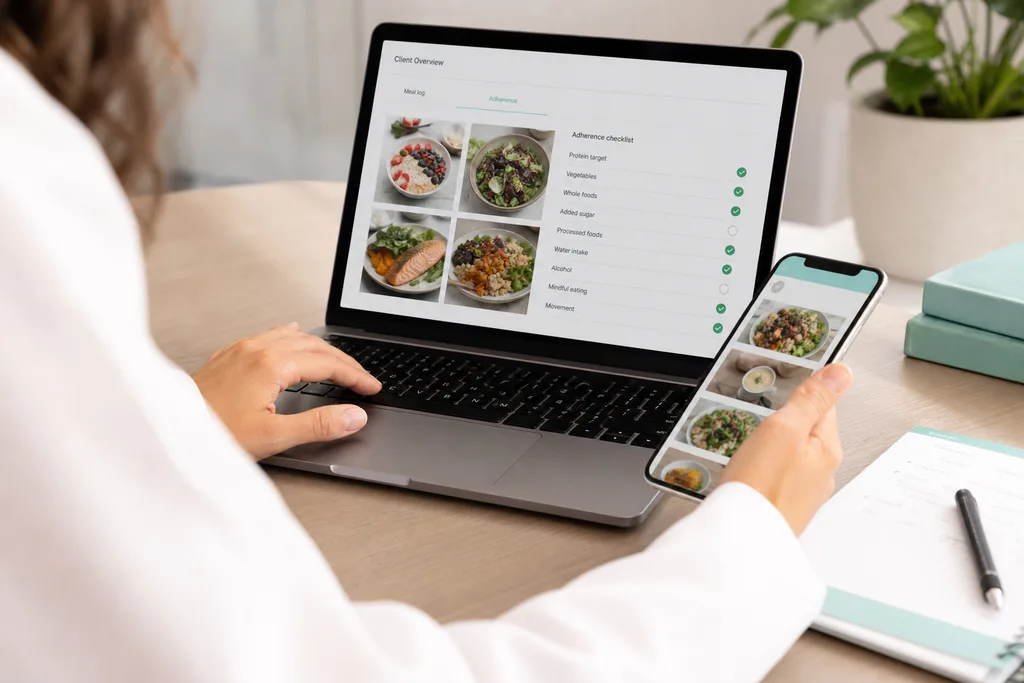
Accountability means you can see the diet in practice: meals logged, adherence checked, and drift caught early—before the next booked session becomes a postmortem.
Self-monitoring of diet (and related behaviors) is the centerpiece of behavioral weight-loss programs (Burke, Wang & Sevick, 2011). Pairing self-monitoring with other self-regulation techniques—goals, feedback, problem-solving—matters even more:
📊 Across 122 evaluations (N = 44,747), interventions that combined self-monitoring with other control-theory techniques had a pooled effect size of 0.42 vs 0.26 for those that didn’t (Michie et al., 2009).
Without that layer, clients quietly drop:
📊 Up to 35% of clients leave due to poor adherence (Vasiloglou et al., 2020).
Practical accountability loop:
- Log — Structured meal capture (photos, text, or voice—not buried chat archaeology)
- Review adherence — Spot missing days and suspiciously light logs
- Habit check-in — Short questions when patterns look off
- Tweak the plan — Adjust for household reality, not perfection
- Repeat weekly — Retention comes from consistency
If follow-ups are drowning you, how to automate follow-ups without losing the human touch walks through the rhythm. Tools like InGreedX Studio turn WhatsApp meal logs into a coach dashboard so adherence reviews take minutes, not hours.
Measure body biomarkers and metrics periodically
“How’s the scale?” is a thin progress story.
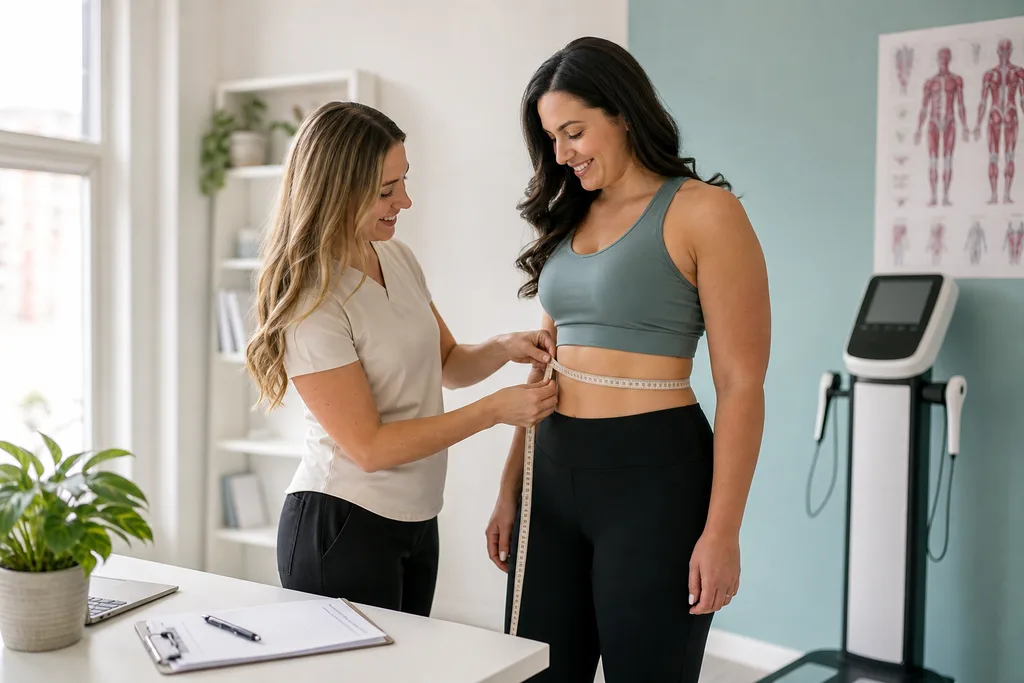
Weight alone doesn’t separate fat from lean tissue or capture abdominal risk. Waist circumference and body-composition methods (BIA, DXA, and similar) give a clearer clinical picture for nutrition care (Holmes & Racette, 2021).
Intensive, measured lifestyle programs—not one unidirectional talk—show what’s possible when metrics are tracked over time:
📊 In Look AHEAD’s first year, intensive lifestyle participants lost 8.6% of initial weight vs 0.7% with diabetes support and education; waist fell 6.2 cm vs 0.5 cm; mean HbA1c dropped from 7.3% to 6.6% vs 7.3% to 7.2% (Look AHEAD Research Group, 2007).
A practical cadence for coaching packages:
| Cadence | What to review |
|---|---|
| Weekly | Weight (or trend), energy, plan adherence / meals logged |
| Monthly | Waist and/or body composition (InBody/BIA where you use it) |
| Per clinical schedule | Labs when available—A1c, lipids, and other agreed markers |
Walk into every session with those numbers. High-value clients pay for coaching that assesses progress, not recaps of last month’s guesswork.
How this becomes a high-value booking
Name the offer clearly:
12-week accountability + progress reviews — not “consultation.”
What the client is buying:
- Meal visibility between visits
- Adherence coaching when logging slips
- Scheduled metric and (when relevant) biomarker reviews
- Plan changes grounded in real data
Why it commands more than a one-off hour: the evidence favors multiple contacts and ongoing monitoring—and multiple MNT sessions are clinically effective and cost-beneficial compared with usual care, including medication-related savings reported in synthesis of dietitian-delivered care (Sikand et al., 2018; Mohr et al., 2023).
You’re not upselling. You’re aligning the booking with how outcomes actually happen.
For the full roster rhythm—onboarding, tracking, check-ins—see how nutritionists manage 100+ clients.
Want bookings that sell progress, not PDFs?
If you’re still priced like a one-way consult, change the system—not the pitch.
InGreedX Studio helps nutritionists:
- Capture structured meal logs (including WhatsApp) in one place
- Review adherence without chat archaeology
- Walk into sessions with clearer between-visit insight
Sell accountability. Measure progress. Book the program—not the hour.
Further reading: Automate follow-ups · Use AI in practice · Bebop Flo blog