Why WhatsApp Alone Fails for Nutrition Client Management
If you’re a nutritionist, coach, or clinic, chances are you started managing clients on WhatsApp.
It’s easy. It’s familiar. Your clients are already there.
But as you grow beyond 10–15 clients, WhatsApp starts becoming less of a tool—and more of a bottleneck.
This isn’t about abandoning WhatsApp.
It’s about understanding why WhatsApp alone is not a scalable client management system.

The Illusion of Simplicity
At first, WhatsApp feels perfect:
- Quick communication
- Easy photo sharing (meals, reports)
- No onboarding friction
But what works for 5 clients breaks at 50+.
You’re not running a chat service.
You’re running a structured coaching system.
1. No Structured Client Data
Everything lives inside chats.
- Diet plans → buried in messages
- Progress updates → scattered across days
- Measurements → lost between images and text
There’s no single source of truth.
You end up scrolling endlessly just to answer:
“What did this client eat last week?”
2. No Standardized Logging
Clients send data like this:
- “Had lunch”
- “Ate rice + something”
- Blurry food images
- Voice notes
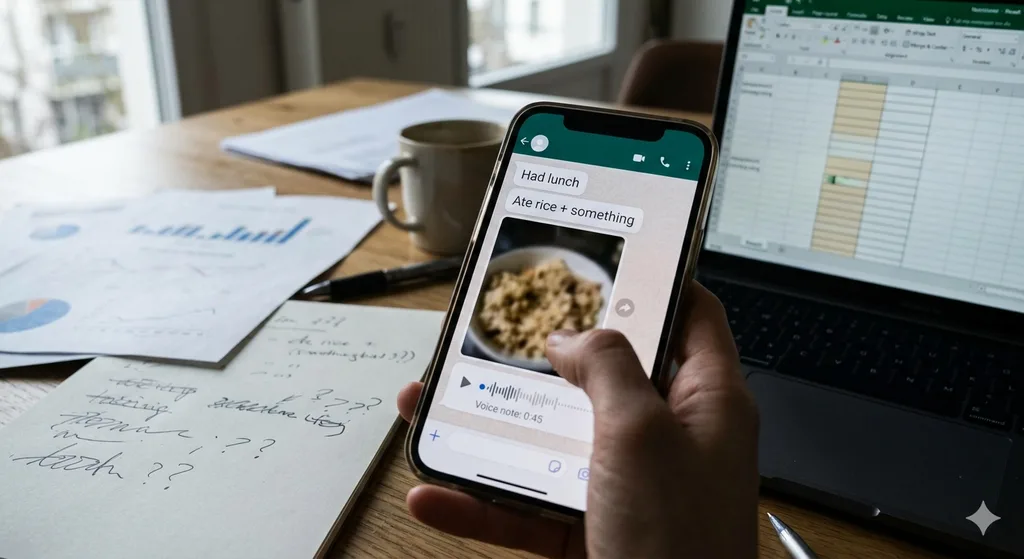
Every client logs differently.
This creates:
- Inconsistent tracking
- Poor data quality
- No way to compare progress across clients
Without structured input, your coaching becomes guesswork.
3. Zero Automation
Every action is manual:
- Sending plans
- Reminders
- Follow-ups
- Check-ins
As your client base grows, your workload grows linearly.
This is the core problem:
Your time becomes the bottleneck to your growth.
4. No Progress Visibility
There’s no dashboard.
To evaluate a client, you have to:
- Scroll chats
- Open images
- Recall past context
This makes it hard to:
- Spot trends
- Adjust plans quickly
- Give data-driven feedback
5. Missed Follow-Ups & Client Drop-offs
With dozens of chats:
- Messages get buried
- Clients get delayed responses
- Follow-ups are forgotten

This leads to:
- Lower adherence
- Poor results
- Client churn
6. Not Built for Scale
WhatsApp is a communication tool, not a client management system.
Once you cross:
- 20 clients → chaos begins
- 50 clients → burnout starts
- 100+ clients → impossible without systems
You start spending more time managing chats than actually coaching.
7. No Insight Layer
WhatsApp doesn’t help you:
- Analyze patterns
- Track adherence
- Generate insights
- Improve outcomes
But modern coaching isn’t just about communication.
It’s about:
Data → Insights → Action
So What Should You Use Instead?
You don’t need to replace WhatsApp.
You need to augment it with a system built for coaching.
A proper nutrition client management system should include:
- Structured meal logging
- Centralized client profiles
- Automated reminders & check-ins
- Progress tracking dashboards
- Coach insights generation
This allows you to:
- Handle more clients without burnout
- Deliver consistent, high-quality coaching
- Scale your practice sustainably
The Hybrid Approach (What Actually Works)
The best setup today is:
- WhatsApp → Communication layer
- Coaching platform → Data + system layer
That system layer is where structured logs, profiles, and follow-ups live so you are not reconstructing a client’s week from scrollback. A platform built for coaching—such as InGreedX Studio—keeps the “what happened” timeline separate from the “quick question” chat.
This way:
- Clients stay comfortable
- You stay organized
- Your business becomes scalable
Final Thoughts
WhatsApp is a great starting point.
But if you’re serious about growing your nutrition practice,
it cannot be your only system.
Because at scale:
Unstructured communication = Unscalable business
Related reading
For a concrete day-to-day workflow once you are past chat-only tracking, read How Nutritionists Manage 100+ Clients (Simple System That Actually Works).
Next step
If you want structured meal logging, client timelines, and less manual follow-up work alongside WhatsApp, explore InGreedX Studio.